Brooklyn Park Core Aeration Plan for Clay Soil Yards
If your Brooklyn Park lawn looks thin, patchy, or struggles to green up even after consistent watering, the problem is almost certainly underneath the surface. The soils across much of Hennepin County — and Brooklyn Park in particular — run heavy with clay. That clay compacts under foot traffic, freeze-thaw cycles, and equipment weight until water and nutrients can barely penetrate the root zone. Core aeration is the most direct mechanical solution available, and when it is timed correctly and paired with overseeding, it can rebuild a compacted lawn more effectively than any fertilizer program alone.
Why Brooklyn Park Clay Soil Creates a Compaction Problem
Clay particles are extremely fine, which is why clay-heavy soils hold moisture well during dry stretches. The downside is that those same fine particles pack tightly together under pressure. In Brooklyn Park neighborhoods like Palmer Lake, Edinburgh, and Noble, where older subdivisions were graded and developed on native glacial clay, that compaction pressure starts from the moment sod is laid. Every mowing pass, every backyard gathering, every hard freeze adds to the problem.
Compacted clay limits the movement of oxygen, water, and nutrients to a depth where grass roots can actually use them. Roots stay shallow because there is no reason to push deeper into anaerobic, impenetrable soil. Shallow roots mean your lawn is more vulnerable to summer drought stress, more prone to winter kill, and slower to recover from any kind of damage. Clay soil in Hennepin County also tends to sit wet in spring, which delays turf recovery and encourages disease pressure in the upper thatch layer.
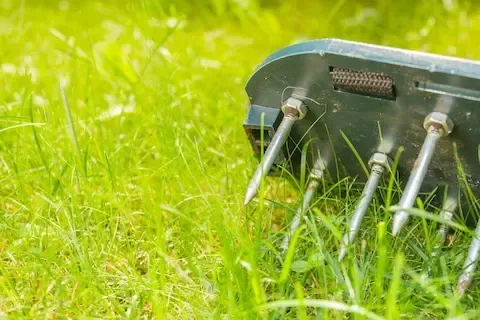
The fundamental goal of core aeration is to mechanically break apart that compaction layer. A core aerator pulls small plugs of soil — typically three to four inches deep — out of the ground at regular intervals across the entire lawn surface. Those holes allow air, water, and fertilizer to move down into the root zone while the exposed soil surface begins to break down thatch naturally.
How Core Aeration Physically Changes Compacted Clay
When a hollow-tine aerator pulls cores from your lawn, it does several things at once. It creates immediate channels into the soil profile. It brings subsoil material to the surface where it mixes with thatch as it breaks down. It relieves lateral pressure in the soil, which gives roots physical room to expand. And it creates seed-to-soil contact points that are essential if you follow up with overseeding.
On a clay-heavy Brooklyn Park lawn, the plugs pulled from a core aerator will often look dense and dark, sometimes with a visible band where the root zone ends and compacted clay begins. That visual tells you exactly how restricted your grass roots are. After aeration, rain and irrigation water will move into the soil instead of sheeting off or pooling at the surface — an immediate improvement you can observe after the first rainfall following the service.
One mechanical pass is helpful. Two passes in perpendicular directions is substantially more effective on heavy clay. On lawns that have gone several years without aeration, the soil is dense enough that a single pass barely makes a dent in the total compaction volume. The plugs also need to be left on the surface to break down naturally — do not rake them up. They break apart within one to two weeks and return organic material to the surface.
Spring and Fall Timing Windows for Brooklyn Park
Timing core aeration correctly in Brooklyn Park means working with the regional climate rather than against it. Minnesota's continental climate gives you two reliable aeration windows per year, and both matter for clay soil lawns that accumulate compaction faster than sandy or loam lawns.
The spring window opens when the soil has thawed to aeration depth — typically four to six inches — and has dried enough that the tines can pull clean cores rather than smearing wet clay across the surface. In Brooklyn Park, that window generally falls between late April and mid-May depending on how quickly the ground dries after snowmelt. Aerating too early into saturated clay is counterproductive. You will close pore spaces rather than open them if the soil is still waterlogged from snowmelt. Reading our post thaw yard damage assessment guide before you schedule spring work gives you a practical checklist for determining when your specific yard has reached aeratable conditions.
The fall window is arguably more important for clay soil lawns in Hennepin County. Late August through mid-September gives you aeration timing that aligns perfectly with overseeding cool-season grasses like Kentucky bluegrass and perennial ryegrass. Soil temperatures at that point are still warm enough to support rapid germination — typically above 50 degrees Fahrenheit at a two-inch depth — and there is enough of the growing season left for new seedlings to establish before frost. Fall aeration also means the root system can capitalize on October and November cool-season growth before going dormant, creating a meaningfully stronger spring emergence.
For Brooklyn Park clay soil lawns that have been neglected or are in poor condition, committing to both a spring and fall aeration in the same year accelerates recovery significantly. The spring pass opens the soil for the growing season and improves water infiltration during summer. The fall pass prepares the seedbed for overseeding and gives roots a chance to push deeper before winter dormancy tightens the soil again.
Overseeding After Aeration on Clay Soil
Core aeration without overseeding leaves the results incomplete on a thinning Brooklyn Park lawn. The aeration holes create ideal seed-to-soil contact points that broadcast seeding on an untouched lawn simply cannot replicate. Seed dropped into or around aeration holes has direct contact with moist soil and is partially protected from desiccation and bird activity. Germination rates on aerated ground run measurably higher than on non-aerated surfaces.
For clay-heavy Hennepin County soils, Kentucky bluegrass remains the standard recommendation for main turf grass because of its cold hardiness, sod-forming rhizomes, and ability to recover from stress. Fine fescue blends are worth considering in shaded portions of the yard where bluegrass struggles, and perennial ryegrass can be added to a mix when you want faster cover because it germinates in seven to ten days compared to bluegrass's three-week timeline. Use a quality seed blend appropriate for Minnesota — not a generic big-box mixture that includes warm-season species irrelevant to this climate.
Seed rate after aeration typically runs two to three pounds of Kentucky bluegrass per thousand square feet for overseeding an existing lawn, higher if you are working with bare or near-bare areas. Starter fertilizer applied at the same time provides the phosphorus needed for root establishment in a soil environment that does not yet have the biological activity of a mature lawn. Keep the seeded area consistently moist — light and frequent irrigation for the first three weeks — because clay soil that dries out at the surface will cause germinating seed to fail even if soil moisture exists deeper in the profile.
Irrigation and Fertilization Adjustments for Clay Soil After Aeration
After aeration, the immediate improvement in water infiltration changes how you should irrigate. Brooklyn Park lawns on clay soil tend to develop irrigation habits that compensate for poor penetration — short, frequent cycles that wet only the top inch or two. After aeration, you can shift to deeper, less frequent watering cycles that train roots to follow moisture down rather than staying shallow. Aim for one inch per week delivered in one or two cycles rather than daily light applications, beginning about four weeks after overseeding once new grass is established.
Fertilization is also more effective immediately after aeration. Granular fertilizer applied within a week of aeration has direct access to the root zone through the aeration channels. Fall fertilization on a freshly aerated lawn should emphasize a late-season application — sometimes called a winterizer — that runs higher in potassium to support root development and cold hardiness. Clay soil in Hennepin County often tests adequate in potassium, so have a soil test done before making blanket assumptions about what nutrient the lawn actually needs.
How Often to Aerate a Brooklyn Park Clay Soil Lawn
The standard recommendation of once-per-year aeration applies to average lawns with moderate compaction. Brooklyn Park clay soil lawns under active use — households with children and pets, lawns that receive regular equipment traffic — benefit from twice-yearly aeration until the soil structure has meaningfully improved. Once you reach a point where water infiltrates well, roots are clearly reaching three to four inches of depth, and the lawn has good density, you can often maintain that condition with a single annual fall aeration.
Lawns that go two or more years without aeration on clay soil typically need two full seasons of twice-annual treatment to recover properly. The compaction layer in those cases is dense enough that single-pass aeration each fall is not removing enough soil volume to create lasting structural change. Committing to a consistent program over two to three years produces results that maintenance-only programs cannot achieve.
Professional lawn aeration services ensure that the right equipment is used for clay conditions. Commercial core aerators penetrate deeper and pull larger cores than consumer-grade rental units, which makes a meaningful difference in compacted Hennepin County clay. They also allow for double passes and can cover larger properties efficiently within the narrow seasonal windows that Minnesota's climate provides.
Building a Multi-Year Recovery Plan for Your Brooklyn Park Lawn
The best results on a clay soil lawn in Brooklyn Park come from treating aeration as part of a multi-year program rather than a one-time fix. Year one should focus on double aeration — spring and fall — combined with fall overseeding and fertilization. Year two continues with spring and fall aeration, spot overseeding of any areas that did not fill in, and consistent irrigation adjustments. By year three, most lawns that were in poor condition are reaching a density and root depth where a single fall aeration and annual overseeding maintains the improvement.
Soil amendments can complement mechanical aeration on extremely compacted clay. Topdressing with a fine compost after fall aeration introduces organic matter that gradually improves soil structure as it works down into the aeration holes. This approach is labor-intensive but produces results that mechanical aeration alone cannot fully replicate on the densest clay profiles found in some Brooklyn Park properties.
A consistent aeration program costs less over time than repeated attempts to rescue a lawn with fertilizer, herbicide, and irrigation alone. The underlying problem in clay soil is structural, and structure can only be corrected mechanically. Once you establish good infiltration, root depth, and turf density, the lawn becomes genuinely more drought-tolerant, more disease-resistant, and easier to maintain through the full range of conditions that Minnesota's climate produces.
