Spring Green-Up Feeding for Brooklyn Park Clay Yards
Brooklyn Park sits in a clay-heavy corridor of Hennepin County where spring green-up doesn't follow the calendar — it follows the soil. If you push nitrogen too early on frozen or saturated ground, you lose most of it to runoff before the turf can absorb a single molecule. If you wait too long, you miss the window when cool-season grass is primed to respond. Getting this timing right is the single highest-leverage thing you can do for a Brooklyn Park lawn all year.
Why Clay Soil Changes the Timing Equation
Clay soil holds moisture exceptionally well, which is both a benefit and a challenge in early spring. After snowmelt, Brooklyn Park yards stay saturated longer than sandy or loam-based lots elsewhere in the metro. That saturation delays soil warming, and it creates a false positive — your grass blades may begin to green up visually while the root zone is still too cold to uptake nutrients efficiently.
The target threshold for applying granular nitrogen on clay-dominant turf is a consistent soil temperature of 50°F at a 2-inch depth, measured in the morning. University of Minnesota Extension recommends this benchmark specifically for cool-season lawns in the Twin Cities region. Brooklyn Park typically hits that window somewhere between late April and mid-May depending on the year, not in late March when the neighbor's lawn looks like it might benefit from a feeding.
What Happens When You Fertilize Too Early
Early application on cold clay does three things, none of them good. First, the grass plant is still in dormancy transition and can't metabolize nitrogen at a meaningful rate. Second, clay's low permeability means excess nitrogen pools near the surface and leaches laterally into storm drains that flow toward the Mississippi River watershed. Third, a heavy flush of early nitrogen on soft, thawing ground can push blade growth faster than root development can support it, leaving your lawn looking lush but structurally fragile heading into summer stress.
For a deeper look at how timing fits into a full-season approach, read our lawn fertilization plan zone 4b guide, which covers the complete schedule from spring green-up through fall hardening.
Choosing the Right Spring Fertilizer Formulation
For clay yards in Brooklyn Park, a slow-release or stabilized nitrogen product is strongly preferred over fast-release urea in spring. The reasoning is practical: clay's limited drainage means any excess soluble nitrogen just sits in the profile or runs off. A slow-release formulation tied to a carrier like polymer-coated urea or IBDU releases nitrogen progressively as soil temperature rises, which matches the uptake curve of cool-season grass almost perfectly.
Look for a fertilizer with a nitrogen-phosphorus-potassium ratio weighted toward nitrogen, with moderate potassium to support root cell integrity. Something in the range of 22-0-4 or 24-0-8 is typical for a spring green-up application in Minnesota. Phosphorus is largely unnecessary at this stage in established Brooklyn Park lawns — most Hennepin County soils already carry adequate phosphorus, and applying it unnecessarily creates regulatory and runoff concerns under Minnesota's phosphorus fertilizer law.
Application Rate and Equipment Setup
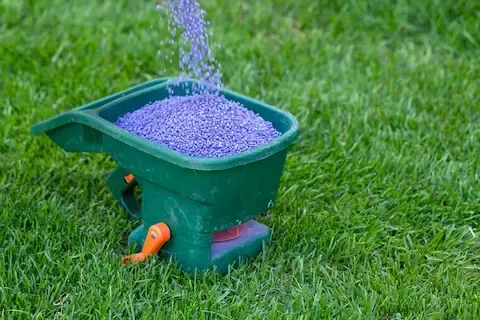
A rotary spreader calibrated to the manufacturer's setting for your specific product is the baseline. For clay-heavy lots, err toward the lower end of the recommended rate range on your first spring pass. You can always make a lighter second pass in four to six weeks as part of a late-spring application. Overloading nitrogen in a single early application on clay does not accelerate green-up — it just increases the fraction that goes unused.
Walk at a consistent pace and overlap your passes by about a third of the spreader's throw width. Clay soil's poor drainage means uneven application shows up clearly: stripes of darker green over the high-rate passes become visible within two weeks and persist through summer. Take the time to calibrate before you start.
Watering In After Application
Granular fertilizer needs moisture to begin dissolving and moving into the soil profile. On clay, this is a nuanced step. You want enough water to activate the product — roughly a quarter inch — but not so much that you saturate already-heavy soil and push soluble fractions sideways. If rain is forecast within 24 to 48 hours and the total expected is less than half an inch, you can skip manual watering. If no rain is coming, a short irrigation cycle is worth running within 24 hours of application.
Avoid applying fertilizer immediately before a heavy rain event. In Brooklyn Park, spring storms can drop half an inch or more in an hour, which will sheet across compacted clay and carry dissolved nitrogen directly toward the drainage system before any root uptake occurs.
Reading Your Lawn Before You Feed
Before reaching for the spreader, walk the yard and assess a few things. Look for areas that are still soft and spongy — those spots are still holding winter moisture and are not ready. Check for any winterkill patches, which will look brown and matted while the surrounding turf is greening. Fertilizing dead or severely stressed grass does nothing useful; those areas need overseeding first, and fertilizer timing around seeding is different from feeding established turf.
Also probe the soil with a screwdriver or soil thermometer in a few spots across the yard. Clay soil warms unevenly — low areas and shaded spots along the north side of structures in Brooklyn Park neighborhoods often run five to eight degrees colder than south-facing open sections. Let the coldest zone reach 50°F before treating the whole yard as ready.
When to Bring In Professional Support
If you've had inconsistent results with spring feeding in past years — patchy green-up, burn spots, or a lawn that looks good in May but struggles through July — the issue is often timing or rate combined with the clay factor. A professional lawn fertilization program accounts for soil type, local temperature trends, and the specific characteristics of your yard rather than applying a generic schedule.
Brooklyn Park's clay-heavy soil rewards patience and precision. A well-timed spring feeding at the right rate, with the right product, sets the turf up for a season of strong, even color without the runoff risk or mid-summer crash that follows a rushed early application.
