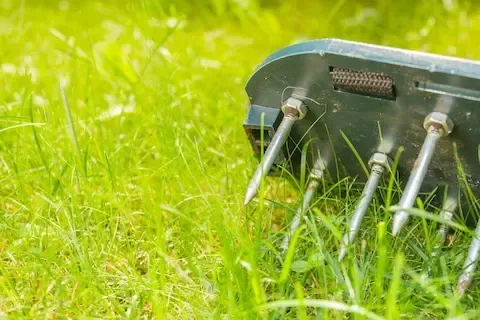
Why Standard Aerators Fail on Brooklyn Park Clay Soil
Brooklyn Park sits on dense glacial till deposited by Mississippi River valley geology — and that soil behaves nothing like the sandy or loam profiles that most rental aeration equipment is designed around. When a homeowner rolls a standard drum aerator across a yard in this area, they often end up with shallow tine penetration, plugs that crumble before they clear the tube, and compaction that barely budges. The equipment isn't broken. It's just built for a different kind of ground.
What Standard Core Aerators Are Actually Built For
The majority of walk-behind core aerators sold or rented at big-box stores and equipment rental shops are engineered for moderate-density soil — think amended loam, sandy lawn bases, or soils that have been worked over multiple growing seasons. Their tines are typically hollow steel, running anywhere from three-quarters of an inch to one inch in diameter, mounted on a rotating drum. That drum relies on the weight of the machine and the rotational force of the tines striking the ground to punch down two to three inches.
In moderate soil, that's enough. The tine enters cleanly, the core ejects through the hollow tube as the next rotation begins, and you're left with a clean hole and a plug sitting on the surface. The machine keeps moving, the operator keeps walking, and by the end of the pass the lawn looks properly aerated.
Brooklyn Park clay doesn't cooperate with that sequence. The tine hits the surface, meets resistance almost immediately, and either bounces out of the soil at a shallow angle or enters but can't eject the plug cleanly because the clay sticks to the interior of the tine tube. You end up with clogged tines, half-depth holes, and a machine that has to be stopped repeatedly to clear the blockage.
How Clay Soil Changes the Physics of Penetration
Clay particles are far smaller than sand or silt particles, which means they pack together tightly with very little air space between them. When that clay is also dry — as it commonly is in late summer Brooklyn Park conditions — the surface can become nearly concrete-hard. Penetration resistance is measured in pounds per square inch, and compacted clay can register three to four times the resistance of loam soil.
For a tine to work at that resistance level, the machine needs significantly more downward force. Standard drum aerators typically generate that force through deadweight alone — roughly 150 to 250 pounds for a walk-behind model. Clay-rated or heavy-duty core aerators increase that downforce through additional ballast capacity, often with water-fillable drums that can push total machine weight past 400 pounds. The tines on these machines are also built with a different wall thickness and a slightly more aggressive entry angle to slice into dense material rather than bounce off it.
There's also the question of tine length. Standard tines run two to three inches. Clay-rated equipment often uses tines of three inches or more, because the compaction in Brooklyn Park clay extends deeper than surface-level. Aerating only the top inch and a half doesn't reach the zone where root restriction is actually occurring.
The Moisture Window Problem
One reason standard aerators fail even more dramatically on Brooklyn Park properties is timing. Clay soil has an extremely narrow moisture window where it's workable. Too dry and it's essentially stone. Too wet and the tines pull out soupy plugs that immediately collapse back into the hole, sealing it off before any gas exchange or root growth can happen.
Standard aerators don't compensate for this window — the operator has to get the timing right. But even with good timing, a lighter machine may still lack the force to punch through soil that's only partially softened. Clay-rated equipment with adjustable downforce and stiffer tine geometry handles a slightly wider range of conditions because it isn't dependent on soil cooperating perfectly.
In practice, this means that a rental aerator brought out after a few days of dry weather in July or August will likely produce almost no usable penetration in Brooklyn Park. The same machine in late September, after a soaking rain, might work adequately — but standard tines still clog more quickly than open-face clay-rated designs.
Why Plug Ejection Matters as Much as Penetration
Aeration isn't just about making a hole. The plug that comes out needs to stay out. It needs to sit on the surface, break down over two to four weeks, and reincorporate its microbial content back into the lawn. If the tine clogs mid-run and you're jamming plugs back into holes to clear the blockage, you've undone the aeration before you've finished the pass.
Clay tines are typically designed with wider internal diameter and smoother interior walls to reduce adhesion. Some professional-grade machines use a slight air gap or a stepped tine design that breaks the clay's suction grip as the tine rotates upward. This isn't a feature you'll find on a standard rental drum aerator, and it makes a significant difference when you're pulling dense, wet clay plugs every three inches across 5,000 square feet of lawn.
What This Means for Brooklyn Park Homeowners
If you've attempted to aerate your own yard and come away with poor results — thin plugs, shallow holes, clogged tines, or a machine that barely moved across the surface — the problem probably isn't your technique. It's the equipment-to-soil mismatch. Brooklyn Park's Mississippi River valley clay is not a standard residential lawn substrate, and the consumer market largely doesn't account for it.
For context on how these equipment differences connect to a full seasonal aeration approach, see our core aeration plan clay soil guide, which covers timing, frequency, and what to do with plugs after the run.
The practical takeaway is this: renting equipment rated for general use and running it on Brooklyn Park clay produces results that look like aeration but don't perform like aeration. The holes are too shallow to reach the compaction layer, the plugs don't eject cleanly, and the lawn doesn't get the oxygen and water access it needs at the root zone.
Equipment Standards Worth Asking About
When you're evaluating whether to hire a lawn care provider or attempt a DIY run, the right questions are about equipment spec, not just price. What is the total operating weight of the machine? What tine length is being used? How is downforce managed across variable soil conditions? Does the tine design account for clay ejection?
A professional using clay-rated equipment with appropriate weight, three-inch-plus tines, and a clean ejection mechanism will produce measurably better penetration depth and plug quality on Brooklyn Park lawns than a standard rental drum run by even an experienced operator. The difference shows up immediately in the plug length sitting on your lawn surface — a clean three-inch plug versus a one-inch crumble tells the story plainly.
If you're ready to have the work done with equipment matched to what your soil actually requires, lawn aeration from a local provider who works Brooklyn Park clay regularly is the most reliable path to results that hold through the growing season.
